







Roof Rack Fuel Economy: Load Smarter, Burn Less
May 30 2026,
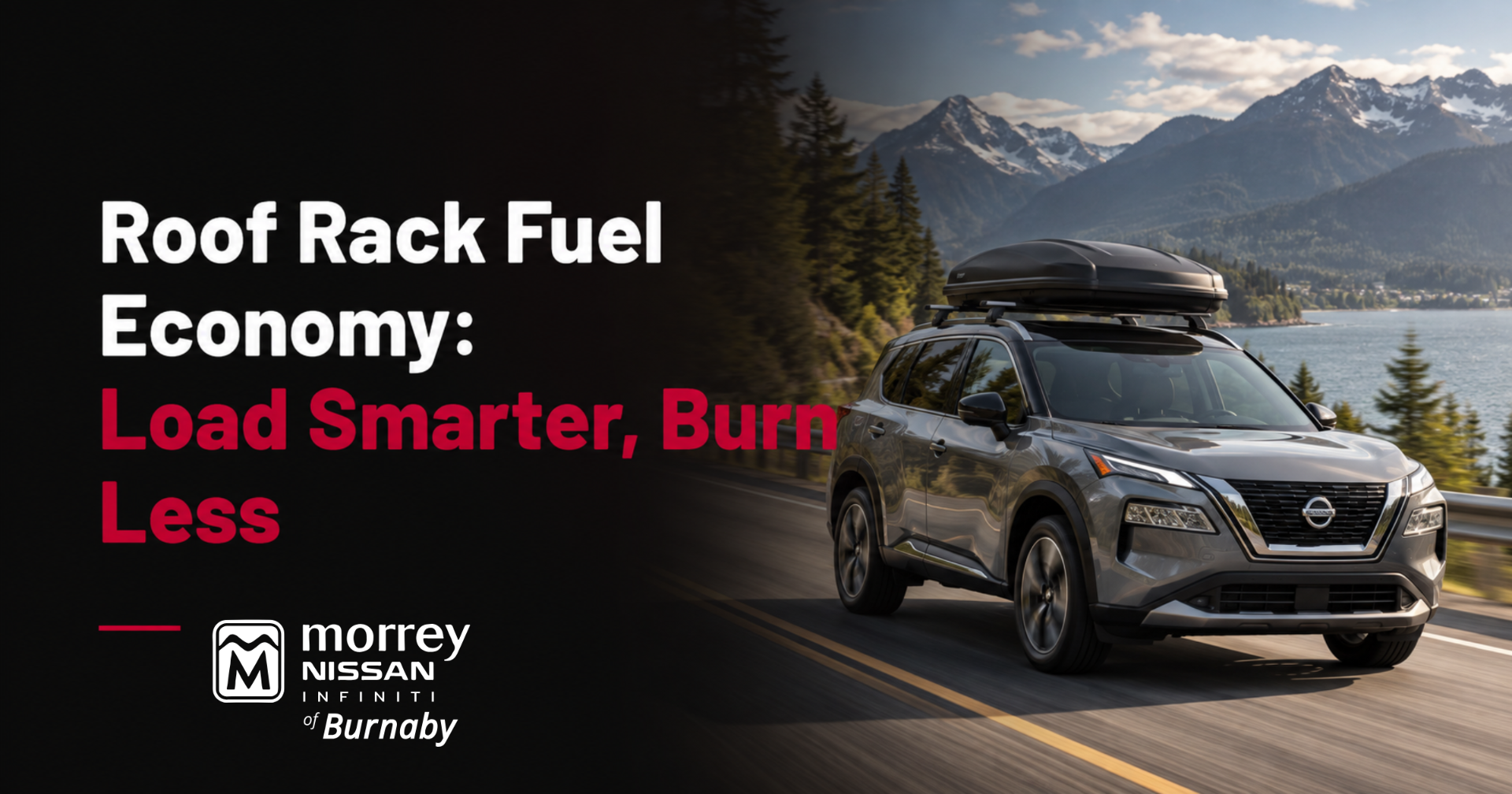
Nobody buys a roof box expecting it to cost them a tank of fuel per trip. But an empty roof box left on all summer, on a vehicle doing regular highway kilometres, quietly does exactly that.
The physics here are unforgiving and mostly invisible. Aerodynamic drag increases with the square of speed, which means the penalty you barely notice around Burnaby becomes substantial the moment you hit 110 on the highway. Where you put your gear matters more than how much of it you have.
This is a practical guide to carrying bikes, luggage, camping equipment and sports gear with the smallest efficiency penalty, plus the safety details that actually matter.
Hitch-mounted carriers cost the least fuel, typically 2 to 6 percent on the highway. Roof boxes cost the most, commonly 10 to 20 percent when loaded. Carrying gear inside the vehicle costs almost nothing. Remove any external carrier when it is not in use, because an empty roof box still carries nearly the full drag penalty.
Why Does a Roof Load Cost So Much Fuel?
A roof load sits in clean, fast-moving air above the vehicle, where it disrupts the airflow the body was shaped to manage. That position produces far more drag than the same object carried behind the vehicle in disturbed air.
Modern vehicles are aerodynamically optimized to a degree that makes this worse rather than better. Manufacturers spend enormous effort smoothing airflow over the roof and off the rear of the vehicle. A box bolted onto the roof undoes a meaningful portion of that work in one step.
Height compounds it. A tall box on tall crossbars catches more air than a low profile box mounted close to the roof. If you are choosing between two boxes of similar volume, the lower and longer one will almost always be more efficient than the taller and shorter one.
You can see baseline consumption figures for any vehicle sold in Canada through the Natural Resources Canada Fuel Consumption Ratings tool, then apply the penalties below to estimate your loaded reality.
Which Carrier Type Costs the Least?
Ranked from least to most fuel penalty: inside the vehicle, hitch-mounted carrier, rear-mounted bike rack, roof-mounted bike rack, roof box. The gap between the best and worst option is large enough to change your fuel budget for a whole trip.
Approximate highway penalties
- Inside the cabin or cargo area: negligible, essentially just the weight
- Hitch cargo tray or hitch bike rack: roughly 2 to 6 percent
- Trunk-mounted strap-on bike rack: roughly 5 to 10 percent
- Roof-mounted bike rack with bikes: roughly 10 to 25 percent, since bikes are aerodynamically terrible
- Loaded roof box: roughly 10 to 20 percent
- Empty crossbars left on year round: roughly 1 to 3 percent
That last figure is the one people ignore. Bare crossbars cost you fuel every day of the year for gear you carry a few weekends a summer. Taking them off between trips is free money.
If you are choosing hardware, browse racks, hitches and cargo accessories and match the carrier to how often you will actually use it.
Is a Hitch Better Than a Roof Rack?
For most people, yes. A hitch carrier sits in the vehicle's wake where air is already turbulent, so it adds far less drag, and it loads at waist height instead of overhead.
The ergonomic advantage is real and underrated. Lifting a 15 kilogram bike above your head onto a roof rack is awkward in a parking lot and genuinely difficult in wind or rain. Hitch racks load at a comfortable height, which means you are more likely to actually use them.
Hitch carriers do have tradeoffs. They can block rear hatch access unless the rack tilts, they extend the vehicle's length for parking purposes, and they require a hitch receiver to be installed. On the other hand, a hitch is useful for far more than bikes, so the installation tends to pay off across multiple uses.
If you want one fitted properly rather than sourced from a marketplace listing, have a hitch or rack fitted so the wiring and receiver rating match the vehicle.
What Are the Load Limits You Should Not Exceed?
Three separate limits apply, and the lowest one governs. There is the roof load rating from the vehicle manufacturer, the rack system's own rating, and the vehicle's total payload capacity listed on the door jamb.
Roof load ratings are lower than most people expect, frequently in the range of 45 to 75 kilograms including the weight of the rack itself. That number goes fast once you add a box weighing 20 kilograms and fill it with camping gear.
There is also a dynamic consideration. Roof ratings assume normal driving. Weight high up raises the centre of gravity and changes how the vehicle responds to sudden steering inputs, which is exactly what you do not want in an emergency avoidance manoeuvre on a highway.
How Should You Decide What Goes Where?
Put heavy and dense items inside, bulky and light items on the roof, and awkward external items like bikes on a hitch. This ordering minimizes both drag and handling disruption.
The practical sort
- Inside, low and forward: tools, water, coolers, canned food, anything dense
- Inside, upper areas: clothing, bedding, soft bags
- Hitch carrier: bikes, generators, firewood, anything heavy and awkward
- Roof box: sleeping bags, tents, camp chairs, light bulky gear
- Nowhere: anything that exceeds a rating, or anything unsecured
Speed is the other lever. Dropping from 120 to 105 kilometres per hour with a roof load recovers a surprising amount of the penalty, because drag scales with the square of speed. On a long trip that choice can be worth more than the carrier decision itself.
The Habit That Saves the Most
Take the rack off when the season ends. That is the single highest-value habit in this entire article, and it costs nothing but fifteen minutes.
Most people install a rack in May and remove it in October, running the drag penalty through months of commuting they never needed it for. If storage is the obstacle, a hitch rack that slides out in thirty seconds solves the problem better than a roof system that requires tools.
Getting set up for the season? Compare cargo capacity across the lineup if you are rethinking the vehicle itself, or book an installation appointment to get a hitch or rack fitted correctly before the long weekend.
Frequently Asked Questions
Does an empty roof box still hurt fuel economy?
Yes, substantially. Drag is created by the shape moving through the air, not by what is inside it, so an empty box costs nearly as much as a loaded one. Removing the box between trips is one of the easiest fuel savings available. Even bare crossbars carry a measurable penalty.
Is a hitch bike rack better than a roof bike rack?
For fuel economy and ease of loading, yes. Hitch racks sit in the vehicle's wake and add far less drag, and they load at waist height rather than overhead. Roof racks preserve full rear hatch access and avoid extending vehicle length, which some drivers prefer for parking.
How much weight can I put on my roof?
Check your owner's manual for the specific roof load rating, which commonly falls between 45 and 75 kilograms including the rack hardware itself. Never exceed the lowest of the vehicle rating, the rack rating and the remaining payload capacity. Weight on the roof also raises the centre of gravity and affects handling.
Does driving slower actually offset the cost of a roof box?
Yes, meaningfully. Aerodynamic drag increases with the square of speed, so reducing highway speed by 10 to 15 kilometres per hour recovers a significant portion of the penalty a roof load creates. On long highway stretches, speed choice can matter as much as which carrier you selected.
Can I put a hitch on any vehicle?
Most vehicles can accept a hitch receiver, but the class, capacity and wiring requirements vary considerably by model. Some unibody crossovers have lower tongue weight and tow ratings than their size suggests. Have the hitch matched to the vehicle's published ratings and installed with proper wiring rather than adapted from a generic kit.