









Hybrid vs Plug-In Hybrid vs Electric: Which One Fits?
June 06 2026,
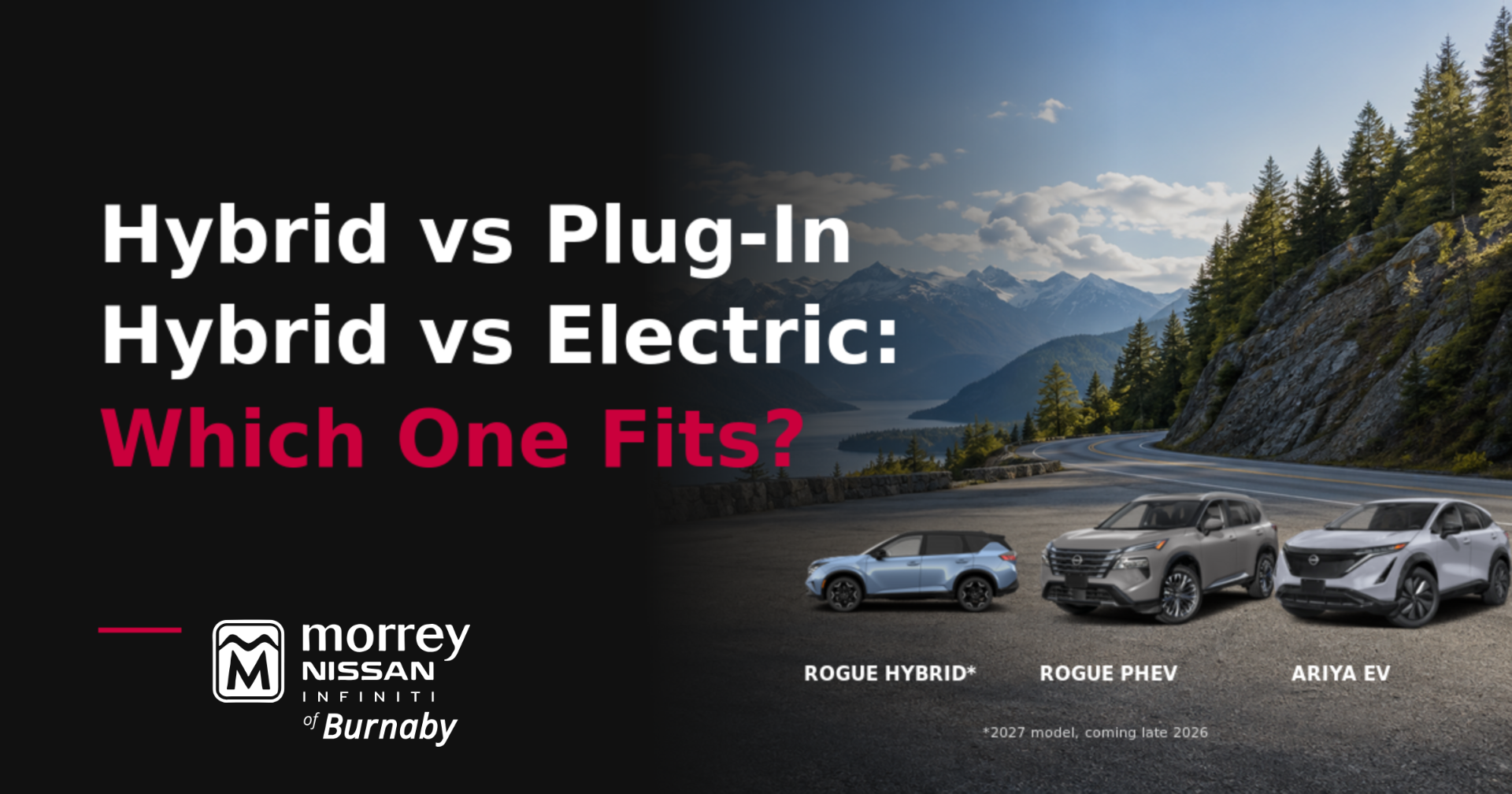
The electrification conversation has a jargon problem. Mild hybrid, series hybrid, PHEV, BEV, EREV, regen, one-pedal. Most of it is engineering vocabulary that escaped into marketing, and it makes a fairly simple decision feel complicated.
It is not complicated. There are three meaningful categories for a shopper, and the difference between them comes down to one question: where does the energy come from, and do you plug it in?
Here is the plain-English version, with the practical implications for someone living in Burnaby, Vancouver or anywhere in the Lower Mainland.
A hybrid makes all its own electricity from gasoline and never plugs in. A plug-in hybrid charges from an outlet, drives a limited distance on electricity alone, then runs as a hybrid. A full electric vehicle has no engine and runs entirely on battery power. The deciding factor is whether you can charge where you park overnight.
What Is a Hybrid, and How Does It Actually Work?
A conventional hybrid uses a gasoline engine and an electric motor together, with a small battery that recharges itself through braking and engine power. You never plug it in and you never change your fuelling habits.
The efficiency gain comes from eliminating waste. A conventional car throws away braking energy as heat and idles the engine at stoplights. A hybrid captures the braking energy into the battery and shuts the engine off when it is not needed. That is why hybrids show their biggest advantage in city driving and their smallest on steady highway cruising, which is the opposite of what most people assume.
There is also a subcategory worth knowing. A mild hybrid uses a smaller electric system that assists the engine but cannot drive the vehicle on its own. It improves efficiency modestly and smooths out stop-start behaviour, but it does not deliver the gains of a full hybrid.
Best for: drivers who want better fuel economy with zero change to their routine, no charging access, or high city mileage.
What Is a Plug-In Hybrid, and Who Is It Really For?
A plug-in hybrid has a larger battery that you charge from an outlet, giving it a meaningful all-electric range, typically somewhere in the range of 40 to 80 kilometres. Once that range is used, it operates as a conventional hybrid on gasoline.
This is the category people misunderstand most. A plug-in hybrid is not a compromise vehicle for people who cannot decide. It is specifically excellent for one profile: someone whose daily driving fits inside the electric range, who can charge at home, and who takes occasional long trips where charging infrastructure would be inconvenient.
For that person, a plug-in hybrid runs as an electric vehicle Monday to Friday and as a hybrid on the road trip to the Okanagan. No range planning, no charging stops, no compromise on either end.
The failure case is equally clear. A plug-in hybrid owner who never plugs in is driving a heavier, more complex hybrid and getting worse fuel economy than a conventional hybrid would deliver. The vehicle only makes sense if you actually charge it.
Best for: drivers with home charging, a commute under the electric range, and regular long trips.
What Is a Full Electric Vehicle?
A full electric vehicle, or BEV, runs entirely on a battery and electric motors. There is no engine, no fuel tank, no oil changes, no exhaust system and no transmission in the conventional sense.
The ownership experience differs in ways that go beyond fuelling. Maintenance is genuinely reduced because there are far fewer moving parts and far fewer fluids. Brake wear drops substantially because regenerative braking handles most deceleration. The vehicle is quiet, immediate off the line, and it starts every morning already full if you charge overnight.
The tradeoffs are real too. Long trips require charging stops that take longer than filling a tank, cold weather reduces range, and the experience depends heavily on whether you have reliable charging where you park. In British Columbia the public network is comparatively strong, and BC Hydro maintains information on the provincial charging network and home charging setup.
Best for: drivers with reliable overnight charging, predictable daily distances, and a preference for the lowest running cost and maintenance load.
What Is the One Question That Decides It?
Ask where the vehicle parks overnight. If you can install or access a charger there, a full electric or plug-in hybrid becomes viable. If you cannot, a conventional hybrid is almost always the better answer.
Everything else is secondary. Range, charging speed, battery size and efficiency ratings all matter, but they only become relevant once the parking question is settled. This is where a lot of Lower Mainland shoppers get stuck, because strata parking, older buildings and street parking complicate what looks simple in a brochure.
Working through your own situation
- Detached home with a driveway or garage: all three options are open, and full electric is straightforward
- Strata or condo with an assigned stall: check your building's EV charging policy and electrical capacity before committing, since retrofits vary enormously in cost and approval difficulty
- Street parking only: a conventional hybrid is the realistic choice unless you have dependable charging at work
- Workplace charging available: this can substitute for home charging on a plug-in hybrid quite effectively
How Does Each One Handle a Lower Mainland Winter?
All three lose some efficiency in cold, but the effect is largest on full electric vehicles because cabin heating draws directly from the battery. Expect a meaningful range reduction in cold, wet conditions.
The good news for this region is that Lower Mainland winters are mild by Canadian standards. Sustained deep cold, which is where electric range takes the biggest hit, is rare here. Coastal drivers see far less winter range loss than drivers in the Prairies or northern British Columbia.
Preconditioning helps considerably. Warming the cabin while still plugged in uses grid power rather than battery power, which preserves range and gives you a warm vehicle. It is one of the genuine quality of life advantages of electric ownership that rarely makes the brochure.
Making the Choice
Start with parking, then daily distance, then trip frequency. That sequence resolves the decision for most people in about two minutes of honest thinking.
If you charge overnight and drive predictable distances, full electric offers the lowest running cost and simplest ownership. If you charge overnight but take frequent long trips into areas with sparse infrastructure, plug-in hybrid is the sharper tool. If you cannot charge where you park, a conventional hybrid gives you most of the efficiency benefit with none of the logistical friction.
Want to see the options in person? See electric vehicles in stock, compare the full lineup, or talk to our service department about EV ownership if you have questions about long-term maintenance. And if you want a straight recommendation rather than a sales pitch, that is why buy at Morrey Nissan of Burnaby.
Frequently Asked Questions
Do I need to plug in a regular hybrid?
No. A conventional hybrid generates and stores all of its own electricity through the gasoline engine and regenerative braking. You fuel it exactly like a conventional vehicle and never plug it in. Only plug-in hybrids and full electric vehicles connect to an external power source.
What happens when a plug-in hybrid runs out of electric range?
It simply continues driving as a conventional hybrid using gasoline. There is no interruption, no warning stop and no loss of performance in normal driving. This is the main practical advantage of a plug-in hybrid over a full electric vehicle on long trips through areas with limited charging.
Do electric vehicles need less maintenance?
Yes, meaningfully less. There is no engine oil, no spark plugs, no exhaust system and no conventional transmission. Brake wear is also reduced because regenerative braking handles much of the deceleration. Electric vehicles still require tires, brake fluid, cabin filters, coolant for the battery system and suspension service.
How much range does an electric vehicle lose in Lower Mainland winters?
Less than in most of Canada, because coastal winters are mild. Cold reduces battery efficiency and cabin heating draws from the battery, so expect some reduction in the coldest weeks. Preconditioning the cabin while still plugged in recovers much of that loss and is the single most effective winter habit for electric owners.
Can I charge an electric vehicle in a condo or strata building?
Often yes, but it depends on your building's electrical capacity and strata policy. British Columbia has moved toward supporting EV charging access in multi-unit buildings, though the approval process, cost and available amperage vary widely. Confirm what is possible in your specific building before purchasing a vehicle that depends on home charging.